
How to Read Your Water Meter
Your water meter is the simplest leak detection tool you already own. Reading it takes a couple of minutes, and it gives you a clear way to track your water use between bills and picks up a hidden leak before it turns into damp walls, a soggy lawn or a bill that makes no sense.
A slow leak between the meter and your house can run for months without a visible sign, and every litre of it is billed to you. Learning how to read a water meter is the fastest way to tell whether water is moving when nothing is turned on, and it is the first thing we check when investigating unexplained water usage.
The video below shows the process on a digital meter, with the written steps underneath.
“How to read your digital water meter” (South East Water)
Where to Find Your Water Meter
WATER METER
Your water meter is usually near the front boundary, in the nature strip, a garden bed or just inside the fence, sitting in a ground-level box with a lift-off lid. You may need to clear soil or leaf litter first. Your stop tap sits alongside it, which is what shuts off water to the house in an emergency.
In units and apartments, meters are usually grouped in a service cupboard or near the building’s main meter. Can’t find it? Contact your building management or owners corporation.
How to Read a Digital Water Meter
WATER METER
Digital meters are being rolled out across Melbourne, and they work differently to the older style. The screen stays asleep until you wake it.
- Open the meter box. Put one hand on the back of the lid, apply gentle pressure and lift from the front.
- Wake the screen. Most models use a light sensor rather than a button, marked by three dots in a triangle or set into the right-hand side. Cover it with your finger. Some newer meters use a small round button below the screen, which needs a touch of less than a second.
- Read the home screen. This shows total water use since the meter was installed, in kilolitres or cubic metres. They are the same thing: one kilolitre equals one cubic metre equals 1,000 litres. You only need the digits before the decimal point.
- Scroll for more detail. Holding the sensor for about three seconds cycles through flow rate, temperature and pressure. Flow rate is the useful one, because it shows whether water is moving right now.
- Record it. Note the numbers and the date, or just photograph the screen.
If the Screen Will Not Turn On
The sensor needs light. In low light or after dark, shine a torch across the meter face while covering and uncovering the sensor. If you scroll too far and get lost, close the lid for three minutes, and it will reopen on the home screen.
How to Read an Analogue Water Meter
Plenty of Melbourne properties still have the older analogue meter, and it is simpler again. The black digits measure kilolitres, and the red digits measure litres. For your bill, you only need the black numbers, read left to right. For leak detection, the red digits matter more, because a leak too small to move the kilolitre count will still turn the litre digits over.
How to Check for Water Leaks Using Your Meter
You can confirm a leak yourself with no special equipment.
- Turn off every water outlet. Taps inside and out, dishwasher, washing machine, irrigation, evaporative cooler and any automatic pool or tank top up. Leave the stop tap at the meter on.
- Take a reading and photograph it.
- Wait at least 20 to 30 minutes with nobody using water. Two or three hours, or overnight, will catch a slower leak.
- Take a second reading and compare.
If nothing has changed, there is no leak on your side of the meter. If the numbers have moved, water is escaping between the meter and your fixtures. Rule out the obvious culprits first: leaking toilets are the most common and the most expensive, followed by dripping taps, faulty irrigation valves and hot water relief valves. If none of those explains it, you are likely looking at a hidden water leak.
Got a Leak You Can’t Find? We’re Here to Help.
Confirming a leak exists is the easy part. Pinpointing it under a slab, driveway, paving or garden bed is where it gets difficult, and guesswork gets expensive.
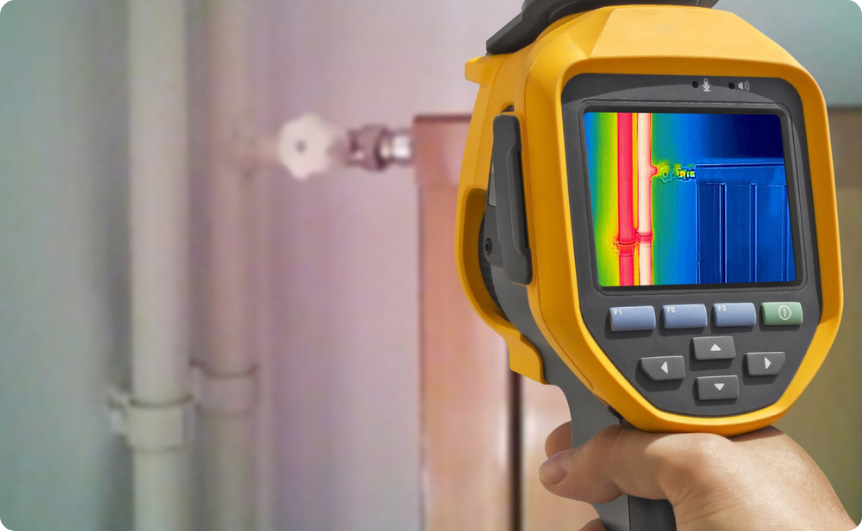
The Leak Detector has over 30 years of experience locating water leaks across Melbourne homes, businesses and strata properties. We use non-invasive methods wherever possible, including acoustic leak detection, pressure testing and thermal imaging, so the leak is found before anything is dug up. You get a clear report your plumber can work straight from. We handle both residential leak detection and commercial leak detection.
If your water meter reading points to a leak, or your bills are climbing and you cannot explain why, get in touch. We are available 24 hours a day for urgent leak issues.